
Directed by: Ronald F. Maxwell
Original Release: October 8, 1993
Theatrical Runtime: 254 minutes
Reviewed Version: Original theatrical release
Based on: The Killer Angels by Michael Shaara
Genre: Historical Fiction / War Drama
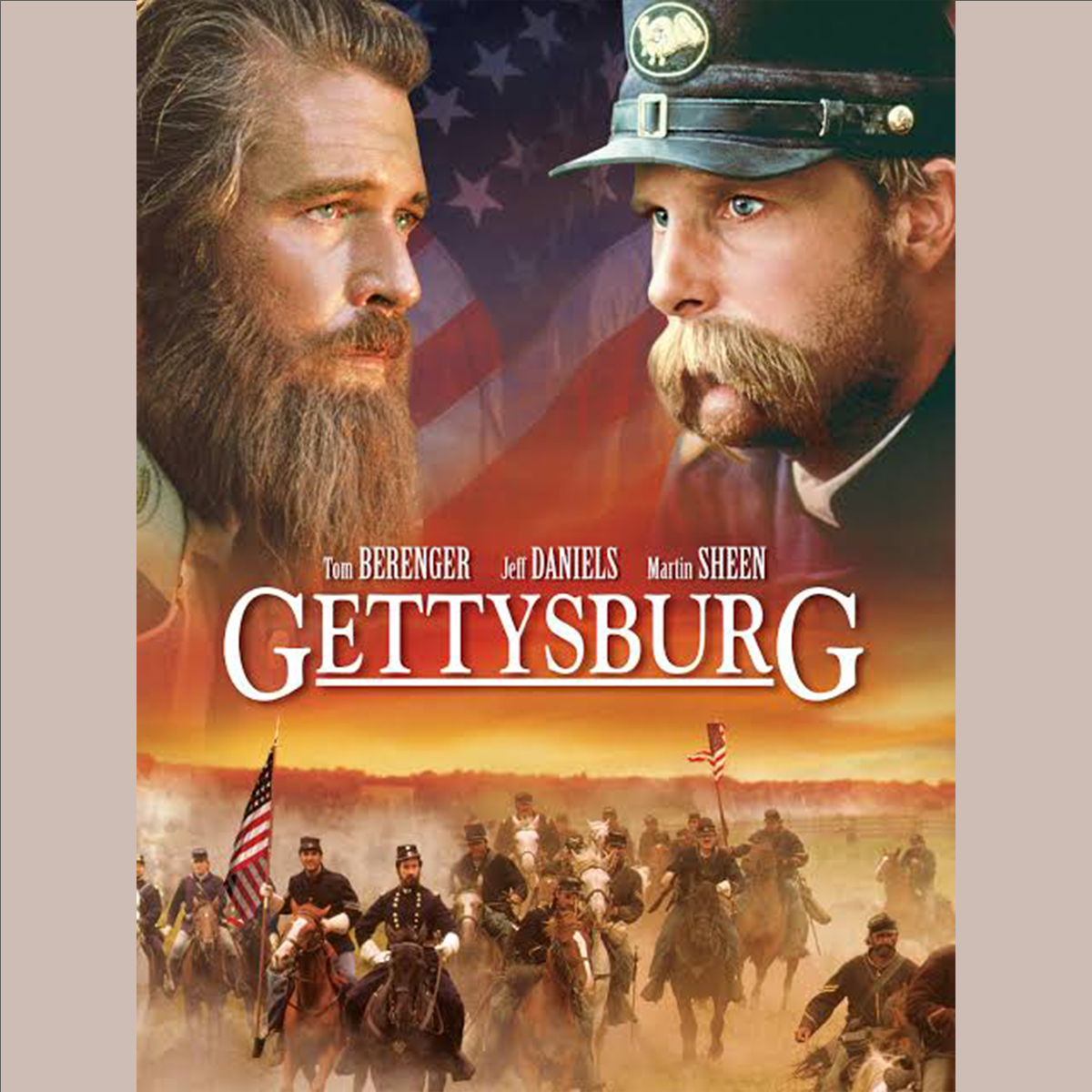
Civil War enthusiasts, history lovers, and viewers willing to settle into a character-driven historical epic.
One of the strongest examples of Civil War historical fiction put on screen. It can be difficult to follow if you’re unfamiliar with the people and events of Gettysburg, but its performances, practical battle sequences, and obvious respect for the history far outweigh its flaws.
Some movies have such an impact that you remember the time and place you first saw it. For me, Gettysburg is one of them. When the film was released in October 1993, I was working as a concessionist and usher at the Willow Knolls 14 movie theater in Peoria, Illinois. I was still a senior in high school and about four months away from a management role that would eventually lead me to serve as Marketing Director for the entire company.
The movie itself was quite special in many ways. The film was to be shown using a 70mm print(instead of the regular 35mm), which required bringing in and setting up a special projector that seemed more suited for a giant to operate than an ordinary human being. The film was too large to fit on one projector platter, so there was an intermission in the middle while we threaded up the second half. Today, you can stream a four-hour movie without ever thinking about how it physically gets onto the screen, but in 1993, the machinery had limits.
The staff was invited to view the film the night before, so of course I took advantage of the offer. There were a few of us that were big Civil War buffs, and the movie didn’t disappoint. It was THE movie everyone was talking about for weeks.
Directed by Ronald F. Maxwell,Gettysburg was adapted from Michael Shaara’s Pulitzer Prize-winning novel The Killer Angels. Maxwell was taking a deeply researched, character-driven novel about one of the largest and most complicated battles of the Civil War and trying to turn it into a movie. Considering the size of that task, I still think what they accomplished is remarkable.
In reviewing Gettysburg, it has to be judged for what it is: historical fiction.
What makes The Killer Angels work so well is what Michael Shaara did before he started filling in the blanks. He studied these people and the battle, trying to understand not only what they did, but what kind of people they were. Shaara could not know every word James Longstreet said to Robert E. Lee or everything Joshua Lawrence Chamberlain thought while standing on Little Round Top, but he could learn how these men wrote and spoke, what others said about them, what frustrated or motivated them, and how they tended to react. Then he filled in the blanks to help give the reader a more complete picture, even thought we’ll never know exactly what was said or thought. Shaara's process took years of study, but in the end I feel he was quite successful in his portrayals.
Maxwell then had the enormous task of putting Shaara’s version of Gettysburg on screen. He had worked with Shaara on an adaptation years earlier, but Shaara died in 1988 and never lived to see the movie go into filming four years later. Thousands of Civil War reenactors participated in the production, many bringing their own uniforms, equipment, experience, and knowledge with them. There were real horses, real artillery, practical effects, and thousands of actual human beings moving across the landscape. The National Park Service even granted special permission for portions of the movie to be filmed on the Gettysburg battlefield itself.
Of course there are inaccuracies, omissions, and simplifications. There have to be. More than 160,000 men fought at Gettysburg over three days, and no four-hour movie can tell all of those stories. But Gettysburg never feels to me as though the name recognition of the battle was simply an excuse to make a movie. It feels like the people making the movie cared about the key things that happened there, and wanted other people to care about it too.
That feeling of familiarity carries over into the performances, several of which have stayed with me for decades. Tom Berenger as James Longstreet, Jeff Daniels as Joshua Lawrence Chamberlain, Richard Jordan as Lewis Armistead, Brian Mallon as Winfield Scott Hancock, Sam Elliott as John Buford, Stephen Lang as George Pickett, and of course Martin Sheen as Robert E. Lee, along with many others, manage to make these men feel like the real human beings they were, rather than names you were supposed to remember for a history test.
Jeff Daniels deservedly receives a great deal of attention for Chamberlain. Shaara clearly admired him, and the film gives Chamberlain some of its strongest moments. For me, nothing in Gettysburg beats Little Round Top. By the time Chamberlain and the 20th Maine are desperately trying to hold the Union left, you understand enough about what is happening to know why it matters.
Kevin Conway also deserves more attention for his portrayal of Buster Kilrain, one of Shaara’s fictional characters. Kilrain gives Shaara someone from outside the world of famous generals and politicians through whom he can talk about class, freedom, equality, and why ordinary men are fighting. His Irish background matters too, as an estimated 150,000 to 200,000 Irish-born immigrants fought in the Civil War on both sides.
Richard Jordan’s Lewis Armistead is a real gem of a performance. Knowing about the friendship between Armistead and Hancock, and knowing where their stories are headed, creates a sadness that hangs over the movie long before Pickett’s Charge begins. Tom Berenger portrays Longstreet brilliantly, as you can feel his frustration with Lee, his growing dread over the July 3 assault, and the burden of being ordered to carry out something he believes is going to fail.
Sam Elliott seems almost born to play John Buford. His scenes during the opening portion of the battle give the first day an urgency that immediately pulls you into the story. Buford understands the importance of the ground before most of the other major characters have even arrived, and suddenly the hills, ridges, and roads around Gettysburg begin to mean something.
Joseph Fuqua’s J.E.B. Stuart also deserves mention. The scene where Lee confronts Stuart after his long absence has always stood out to me because there is almost a father-and-son quality to the relationship as the movie presents it. Stuart is humiliated by the suggestion that he failed Lee and immediately wants to defend his honor, while Lee is angry and disappointed but clearly does not want to destroy the young man standing in front of him.
Historically, Stuart’s movements during the Gettysburg Campaign have been argued over ever since the battle, including what Lee expected from him and how much blame Stuart deserves. Given that Stuart dies in 1864 at age 31 at the Battle of Yellow Tavern, I believe many throughout history have been hesitant to put too much of the blame on his young shoulders. What is clear is that Stuart did not arrive at Gettysburg until the afternoon of July 2, leaving Lee without the cavalry intelligence he normally depended on while a major battle was taking shape around him. The movie takes that huge military problem and makes it personal.
Martin Sheen was probably the most recognizable name in the cast when the movie was released, playing Robert E. Lee, but his performance has never worked quite as well for me as some of the others. There are other portrayals of Lee that I find more convincing. Sometimes I feel as though I am watching someone portray the idea of Robert E. Lee rather than disappearing into the man himself.
Then there is Stephen Lang as George Pickett. Pickett does not receive nearly the character development given to Longstreet, Chamberlain, or Armistead, which is unfortunate because Lang is wonderful in the role. He enters the story relatively late, suddenly becomes enormously important because history requires him to become enormously important, and then carries one of the most famous moments of the battle. Lang manages to give him youthful energy and personality with comparatively little time to do it, only to see a broken man at the end when he realizes he & his men were not invincible after all.
Years later, Lang would return to Maxwell’s Civil War world as Thomas “Stonewall” Jackson in Gods and Generals. I have quite a lot to say about that performance, and that movie, but we will save that for another review.
The relationships between the Confederate commanders matter because Lee came into Pennsylvania with enormous confidence in the Army of Northern Virginia. His army had inflicted a devastating defeat on the Union at Fredericksburg in December 1862, followed by Chancellorsville in May 1863, one of Lee’s most remarkable victories.
But the army that arrived at Gettysburg was missing someone very important. Confederate General Thomas “Stonewall” Jackson had been accidentally shot by his own men during the Battle of Chancellorsville and died on May 10, less than two months before Gettysburg. Jackson had been one of Lee’s most aggressive commanders and had played an enormous role in what happened at Chancellorsville.
Longstreet, meanwhile, had not been engaged there. He and part of his corps were operating around Suffolk, Virginia, while Lee and Jackson fought Union General Joseph Hooker. Longstreet was a different kind of commander than Jackson. He was more comfortable using defensive tactics as part of a larger offensive strategy, and throughout Gettysburg he had serious reservations about attacking strong Union positions.
People have been asking for generations whether the Confederacy would have won Gettysburg if Stonewall Jackson had lived. Maybe they would have. Maybe not. It is one of those historical questions we can argue about forever, but focusing only on Jackson also ignores everything else that went wrong.
Stuart’s delayed arrival deprived Lee of cavalry intelligence at a critical time. Confederate commanders were working with unfamiliar roads and terrain. The battle began before Lee intended to fight a major engagement there, and orders were given that were not always understood the same way by the person receiving them. Meanwhile, the Union Army was fighting on its own ground against an invading Confederate army. Once Union troops occupied strong defensive positions around Gettysburg, Lee still had to find a way to get them off that ground.
By July 3, Lee remained convinced his army could break the Union center, while Longstreet did not share that confidence. The movie makes that painfully clear, and when Pickett’s Charge fails, Lee rides among the survivors accepting responsibility. He had asked too much of them.
For me, that moment matters because Lee’s confidence did not come out of nowhere. He had watched this army accomplish extraordinary things, most recently at Fredericksburg and Chancellorsville, and he and his men must have felt almost invincible. But Gettysburg was different. Jackson was gone, Stuart had been absent when Lee desperately needed information, Longstreet did not see the battlefield the way Lee did, and the Union occupied excellent defensive ground and was determined to hold it. A lot went wrong for Lee over those three days, and thousands of his men paid for it.
This is also where my feelings about Gettysburg become more complicated. The movie spends a tremendous amount of time inside the Confederate command structure. We know Longstreet’s fears. We learn about Armistead’s friendship with Hancock. We witness Lee’s decisions, Pickett’s enthusiasm (followed by complete shock and heartbreak), Stuart’s shame, and the emotional bonds between these men.
The Union side certainly has memorable characters, particularly Chamberlain, Buford, and Hancock, but the emotional balance often feels different. The Confederate characters are given a great deal of personal time, and because the writing and acting are so effective, it becomes difficult not to feel something for them. I don’t think that is necessarily a bad thing.
These were human beings. They had friendships, families, fears, and shared histories. Some of them had served together in the United States Army before finding themselves trying to kill one another. Families were divided, and friends ended up on opposite sides. Hancock reminds us that it’s a bizarre situation when he makes the point that he doesn’t want to see his old friend Armistead, not like this (in battle), but hopefully they will see each other again after the war. (spoiler: they won’t.)
I can feel sorrow over the loss of those lives without supporting the cause for which the Confederacy fought. I can have empathy for someone while still believing that person was profoundly wrong, and I can mourn what was lost when someone died while recognizing that slavery was an immoral institution and preserving it was not a cause worthy of defense. Feeling something for these people does not require forgiving them or agreeing with them.
I think that is one reason Gettysburg remains so affecting for me. By the time thousands of Confederate soldiers begin walking across that enormous field during Pickett’s Charge, they are no longer simply an enemy force moving toward the Union line. We know Armistead and Pickett, and we know Longstreet does not want them to go. We also know what is going to happen to them, which makes Pickett’s Charge a little heartbreaking to watch.
But there is another side of that sequence that viewers unfamiliar with the history may not fully understand. When Union soldiers begin invoking Fredericksburg as the Confederate attack collapses, that name carries a great deal of weight.
Only seven months earlier, Union soldiers at Fredericksburg had repeatedly advanced across exposed ground toward Confederate infantry protected behind a stone wall along the Sunken Road at Marye’s Heights, with Confederate artillery positioned on the high ground. The Union suffered approximately 12,500 casualties at Fredericksburg compared with about 6,000 Confederate casualties.
At Marye’s Heights, wave after wave of Union soldiers crossed open ground while Confederate soldiers behind the stone wall and artillery above them poured fire into the advancing ranks. Descriptions of the slaughter can sound almost unbelievable. There were accounts suggesting the Confederates barely needed to aim because the Union troops were so exposed and packed into the killing ground in front of them.
Standing at Fredericksburg today and looking toward Marye’s Heights, it is difficult to imagine being ordered to make that walk. Seven months later at Gettysburg, the positions were reversed. Now Confederate soldiers were advancing across open ground toward Union infantry and artillery, and many watched as the nightmare they had experienced happened again, but this time they were behind the stone wall. We can feel how important and fulfilling this victory is to those in the Union uniforms, who honestly did a phenomenal job in those incredibly difficult three days of fighting. I still remember the cheers of the audiences in the theater when the Union won their victory.
Understanding Fredericksburg does not mean we have to celebrate what happened to the Confederates during Pickett’s Charge. It helps us understand why Union soldiers who had lived through Fredericksburg reacted the way they did, and that is something I think Gettysburg does very well when you already know the history. One line in the movie can carry the weight of thousands of dead and wounded men.
Pickett’s Charge is probably my second favorite battle sequence in the movie, just behind Little Round Top, and a big part of what makes it work is simply seeing all of the reenactors participate.
Gettysburg was made before digitally created armies became commonplace in large historical productions. When thousands of soldiers move through smoke, struggle over fences, and continue across that field, you are largely looking at actual people doing those things. You begin to understand the distance, how long they are exposed, and how the formations become less perfect as they keep moving.
The smoke does whatever the smoke is going to do. Horses behave like horses. Thousands of reenactors do not move with the absolute uniformity of digitally duplicated soldiers, and I like that. There are things modern visual effects can accomplish that would have been impossible in 1993, but there is something about knowing those are real people physically crossing real ground that gives these scenes a different feeling.
Gettysburg is also a battle where the geography matters. Once you have been there, you understand that even more. Standing on Little Round Top or looking across the fields toward Cemetery Ridge changes the way you see the movie.
Randy Edelman’s score has always been one of my favorite parts of Gettysburg. Movie theaters regularly received promotional soundtrack CDs during that period, and this was one I heard constantly while working. Sometimes it was while cleaning an auditorium, or late at night when I was entering inventory numbers at the manager’s desk.
After a while, the music became connected in my mind not only with the movie, but with that entire period of my life. More than thirty years later, the soundtrack is still in my music collection. I even keep a folder of music I listen to while working on Civil War history because music helps put me in the right frame of mind for whatever story I am working on, and Gettysburg is in that folder.
I think some of the best movie music is the music you almost stop noticing because it becomes so much a part of the scene that you are not consciously thinking, “Here comes the emotional music.” You are simply feeling the scene, and for the most part, Edelman’s score does that for me.
Of course, Gettysburg is not afraid of sentimentality. There are long conversations. Men stare into the distance and talk about honor, friendship, home, and what it all means while the music rises underneath them. Some of those speeches probably could have ended a few sentences earlier, but most of the time I don’t mind. The music makes it ok.
One of the things Michael Shaara understood extremely well is that knowing what happened in a battle is not quite the same thing as understanding what happened there. Dates matter, troop movements matter, command decisions matter, and casualty numbers certainly matter, but eventually you have to get down to the people inside all of it.
Gettysburg gives us professional soldiers and volunteers, generals and sergeants, teachers and immigrants, old friends and divided families. Some are brave, some are frightened, some make brilliant decisions, and some make terrible ones. Sometimes a man lives because someone nearby makes the right decision, while thousands of men can suffer because someone farther away makes the wrong one.
I have always thought of The Killer Angels as something of a love letter to the people who fought at Gettysburg, and I think Maxwell mostly carried that spirit onto the screen. Ironically, one of the movie’s greatest strengths also creates its biggest problem: Maxwell and Shaara know these people so well that the movie sometimes seems to forget that the audience may not.
For someone already familiar with Gettysburg, that works beautifully. The movie can move straight into relationships, decisions, and disagreements without stopping every few minutes to explain who everyone is. For someone encountering the battle for the first time, though, it can get confusing very quickly.
I saw that firsthand in 1993. The theater was frequently filled not only with Civil War enthusiasts, but with students who had been assigned to see the movie for a history class. More than a few wandered into the lobby during the intermission, and occasionally right in the middle of a scene, trying to figure out who someone was, what had just happened, or why a particular moment mattered. When I had time, I would help them sort it out and sometimes walk back into the auditorium with them while quietly explaining who they were watching.
The opening credits came frustratingly close to solving some of this. Photographs of the real historical figures transition into the actors portraying them, but the emphasis is placed on the actor’s name instead of clearly identifying the historical person. If you already know what James Longstreet, John Buford, Lewis Armistead, Jeb Stuart, or Winfield Scott Hancock looked like, it works beautifully. If you don’t, you may still have no idea who anyone is, and when you have that many officers, uniforms, beards, and mustaches competing for your attention, it matters.
A little more orientation would not have hurt the story or required turning Gettysburg into a classroom lecture. It simply would have made it easier for people who were meeting these historical figures for the first time to understand what they were watching.
Absolutely. I give Gettysburg 4.5 out of 5 stars because it is not perfect, but the good far outweighs the bad.
If your knowledge of Gettysburg begins and ends with knowing there was a major Civil War battle there and Abraham Lincoln later gave a famous speech, I would not recommend going into the movie completely cold. At minimum, familiarize yourself with the basic structure of the three-day battle and a few of its principal commanders first.
Better yet, read The Killer Angels, or even better than that, listen to the audiobook. It is phenomenal. Shaara gives you some of the character foundation the movie is missing, and once you know Chamberlain, Longstreet, Armistead, Buford, Hancock, Stuart, Pickett, Lee, and the others on the page, seeing them appear on screen becomes much easier to follow and much more meaningful.
Watching Gettysburg at home also has one enormous advantage over watching it in a theater in 1993: you can pause. Look up an officer, pull up a battlefield map, find real photographs of Little Round Top and the ground crossed during Pickett’s Charge, rewind a scene, or ask your choice of AI what actually happened compared with what the movie shows, then follow the sources if something catches your interest. Maybe you’ll even find yourself planning a trip to Gettysburg to see it all for yourself.
I know some modern viewers will find Gettysburg too slow. There are long conversations, a great deal of character development, and the movie is more than four hours long. If someone needs something exploding every five minutes, this probably is not the movie for them, and that is their loss. For me, those quieter moments are part of what makes the battle matter when it finally comes.
Gettysburg did something relatively few historical movies manage to do. It took real people, a real place, and an enormously complicated event, then used historical fiction to help us imagine what it might have felt like to be among them without making the real history feel secondary to the story.
More than thirty years after its release, I still believe it is one of the strongest examples of Civil War historical fiction ever put on screen. Maybe what stays with me most is the feeling I had when I first saw it all those years ago. This was more than a group of people making a movie. They cared about these people, this place, and this history, and many of them carried that connection with them long after filming ended. No matter how many times I watch Gettysburg, I can still feel it.
One thing I could not have appreciated when Gettysburg first came out was how deeply some of these actors would remain connected to the history afterward. Stephen Lang, Tom Berenger, Brian Mallon, and other members of the cast have returned to Gettysburg over the years for commemorations, screenings, historical programs, and anniversary events. Lang, in particular, has developed a remarkable relationship with Gettysburg and Civil War history. In fact, it was recently announced that Bo Brinkman, who played Lee’s aide, Major Taylor, just wrote and directed a new film titled Gettysburg 1863, which is coming out in November 2026.
Many members of the cast and crew came back again for the film’s 30th anniversary in 2023. I could not have known in 1993 that some of these actors would still be coming back to Gettysburg and talking about these people three decades later, but looking back, it makes sense. You can feel that connection they have to their real counterparts in this film. And that makes this film a must-have in any Civil War history buff’s collection.
.svg)


© 2011–2026 The Civil War Project. All Rights Reserved. Content may not be reproduced or scraped without permission.